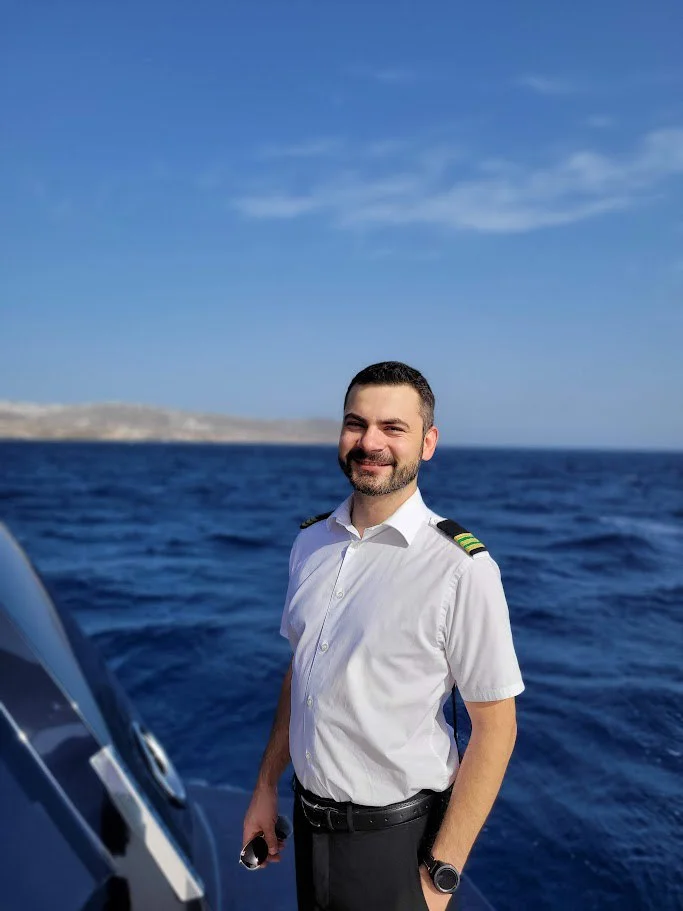
In luxury service, there is one word you hear more than any other. When a guest on a yacht asks for something - jet skis at eleven, dinner for six, ice in the cabin - the response is always the same.
Understood.
After almost ten years at sea, first on tall ships and then on superyachts, I can tell you: that word isn't always true. Sometimes it's just hope.
I grew up in Serbia. When I was thirteen, my mother's best friend came to visit. She worked on ships. She pulled a photograph from her bag.
A sailing ship. Four masts. White sails against blue sky.
"This is where I work," she said. "Sea Cloud."
Sea Cloud. Launched in 1931. Nearly a century on the water. I stared at that picture like it was a portal to another world. I said: "One day, I'm going to walk on that deck."
I didn't know how. But I knew I would.
Fifteen years later, I'm wearing a uniform. Same ship. First time I had ever seen the sea in person. The woman who showed me that photograph worked alongside me. It turned out the picture was exactly what it looked like - a portal to another world. And I met my wife on that vessel.
After Sea Cloud, I moved to superyachts. Bigger. More complex. State-of-the-art technology in every cabin - automation, touchscreens, sensors under the deck.
I was the ETO. The Electrotechnical Officer. The person responsible for every system on the vessel, from the engine room automation to the AV to the internet that somehow only dies during the owner's conference call - or worse, the Champions League final.
On one leave, my wife took me to Schwetzingen Palace near Heidelberg. Beautiful place, standing since the 1300s. And I noticed these ropes running through the walls. From every room, all the way down to the ground floor.
A servant call system. Centuries old. Guest pulls the cord, a bell moves downstairs. The servant sees which room, walks up, knocks. "How may I help?"
Back on the yacht, watching a cabin number light up on a panel, I understood something for the first time. We had replaced the rope with wireless and the bell with a screen. But when a guest pressed a call button at three in the morning, the stewardess still walked in blind.
She still had to guess. Still had to stand in a doorway with no context, smile, and wait for hand gestures she might not understand.
The technology had changed. The problem hadn't.
Ten years of this. Different yachts. Same story.
A Chinese guest speaks into the air. A stewardess arrives who doesn't speak Mandarin. A Russian family tries hand gestures with a French crew member. An Arabic charter party and a predominantly Eastern European crew, working together, smiling, nodding, hoping.
I had a front-row seat to every single time that system failed. And most nights, I was running with them.
Meanwhile, my kids were growing up on a screen. Monaco for breakfast. Portofino by lunch. The views were extraordinary. But you miss the first steps. The first words. You are not there for bedtime. And you know you can't get that time back.
So I made a choice. Not yet to quit - but to stop waiting for someone else to fix this.
I had an IT degree. I knew how systems worked. But building a product from scratch, with no investors, no tech connections, nobody in my world who understood what I was even trying to do - that was a different game.
For years I looked for someone who believed in this. Nobody did. I was about ready to let it go.
Then I met Niko. Our kids were in the same kindergarten. We barely knew each other - maybe two days acquainted - when I found myself talking about this idea I couldn't shake. How I'd been stuck. How I didn't know where to start.
He looked at me - this man who owed me nothing - and said: "Just start. Do something. Just start."
Sometimes a stranger hands you exactly what you needed.
I went home that night. Next morning, I started.
"AI gave me the tools. Ten years at sea gave me the knowledge of what to build. While others design systems in boardrooms, I watched crew actually work. That's the advantage you can't download."
I didn't use AI. I abused AI. Every coffee break. Every lunch hour. Every leave. Hardware designers. An iOS developer. An Android developer. Backend, frontend. Whatever solved the problem, I used it.
The idea evolved. It started as a radio button. Then a round display with a dial - scroll to pick your service. Nobody has time for that. I stripped it down. One press. You speak. That's it.
Privacy had to be built into the hardware, not software. The microphone turns on when you press. Not before. Not ever. Because crew and guests told me the same thing when I asked: they didn't want a listening device in the cabin.
I went through dozens of circuit boards. Every small change meant a new design, a new prototype, a wait for it to ship. Until I finally got it right.
Then Mr. Smith called. Mister Smith - a luxury yacht charter concierge company in the Netherlands. The first time I ever showed this to anyone. One demo. They saw voice-to-text translate a spoken request into another language in real time, and the room stopped.
They invited me to METSTRADE in Amsterdam. Their booth. Their guest. After years of closed doors - one conversation changed everything.
New circuit boards arrived the Friday before the show. Niko and I soldered all night.
Monday morning, the booth opened. And I watched something happen. People got it - immediately. Not just the tech integrators. The captains. The crew representatives. The people who had lived this frustration for years. They didn't need an explanation. They needed a quotation.
I knew right there, in the middle of that trade show floor: I was quitting my job. I was going all in.
I quit. Walked away from the salary, the security, everything I had worked for. My family believed - enough to risk it all alongside me.
The name comes from Latin. Obedire. To obey. A perfect butler who is invisible until you need them.
A few months after launch, a steward sent me a message. He said: "With OBEDIO, you're not solving problems. You're preventing them." That hit me right here - because that's exactly what I'd been chasing for a decade. He put it into words better than I ever could.
In March 2026, Obedio went to the Superyacht Technology Show in Barcelona. By the end of the second day, the stand was the busiest on the floor. That evening I had dinner with the Director of Crestron Marine - a company whose certification courses I had taken years earlier, when I was still an ETO trying to get better at my job. We are now partners.
Obedio is live on superyachts. The first units are deployed. More are coming. The system handles guest requests across cabins, decks, and languages - offline, which is the only option that actually works at sea.
Everything in my life led here. A photograph when I was thirteen. A rope running through the walls of a castle. Ten years watching crew struggle to keep up.
Understood. This time, it's not just hope.
Obedio is a yacht crew call system and superyacht guest service platform. The SmartButton uses offline voice-to-text and 100+ language translation to route guest requests to the right crew member - with no cloud dependency, a two-year battery life, and full integration with Crestron, Control4, and KNX. Built by crew, for crew.
See the system